
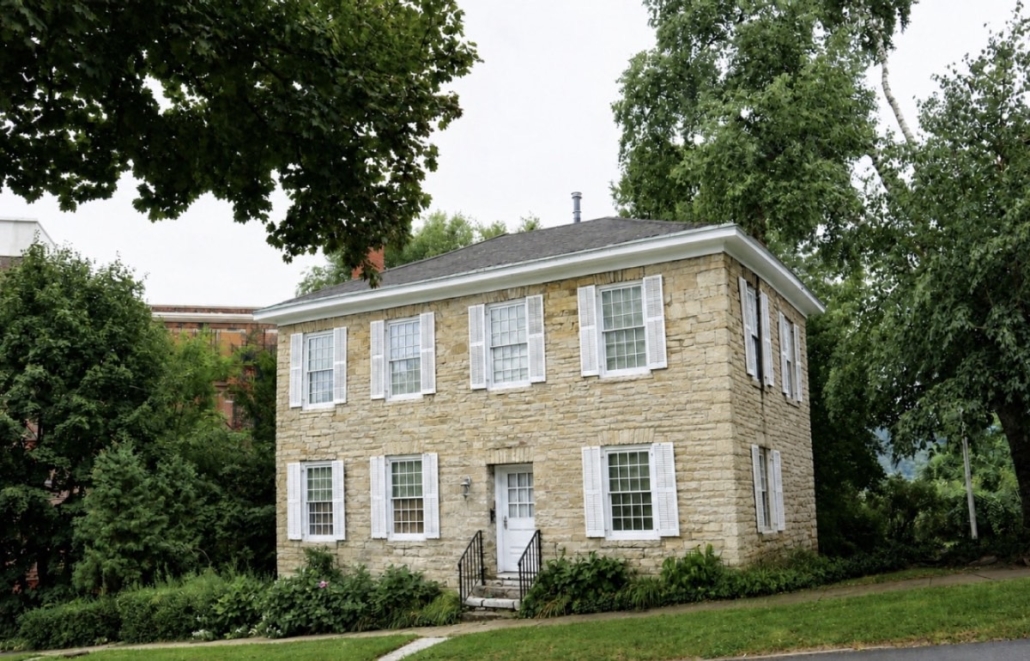
FIGURE 2.12
The First Schoolhouse.
Photograph © Elizabeth Spraker.
THE FIRST SCHOOLHOUSE
15 Church Street, Little Falls, New York
A Federal-Style Stone Landmark of Early Education
ARCHITECTURAL OVERVIEW
Imagine Church Street in the closing years of the eighteenth century, when Little Falls was still a small settlement surrounded by rugged terrain, scattered homes, mills, and unpaved roads. Against that early landscape, the First Schoolhouse would not have appeared grand. Its importance was expressed through sturdy walls, practical proportions, and the unmistakable intention that it should endure.
Today, the building rises two stories beneath a low hipped roof. Its compact rectangular form gives it a solid, self-contained appearance, while the evenly spaced windows introduce the balance and order associated with the Federal period. The design is simple, but each part contributes to a calm and carefully arranged composition.
The limestone walls immediately distinguish the Schoolhouse from the brick and wood buildings found elsewhere in the Historic District. The stones vary slightly in size, shape, and tone, allowing the craftsmanship of the masonry to remain visible across the façade. Their pale, weathered surfaces give the building warmth while also revealing the strength that has allowed it to withstand more than two centuries of changing seasons.
Tall, multi-paned windows are arranged across both stories, bringing daylight into the interior. Their white frames and shutters stand out clearly against the textured limestone. Rather than relying upon carved ornament or elaborate trim, the façade gains its character through the repetition of these openings and the visual contrast between stone, glass, and painted wood.
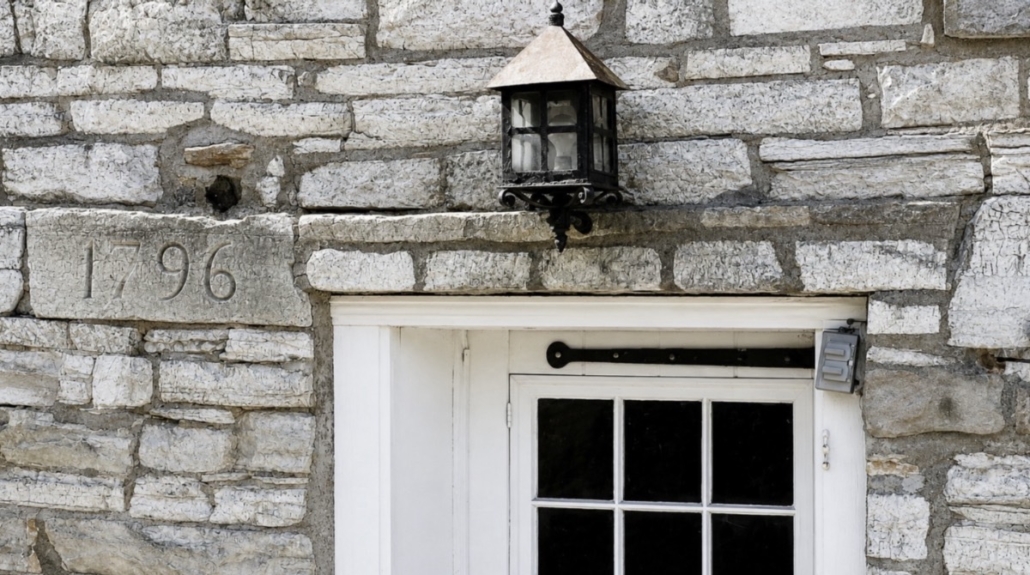
FIGURE 2.13
1796 Date Stone Carving.
Photograph © Elizabeth Spraker.
The entrance is modestly positioned near the center of the front elevation. Above it, a limestone block carved with the date 1796 preserves a direct connection to the Schoolhouse’s earliest beginnings. Small and easily overlooked, the carving is among the building’s most meaningful exterior details. It marks the year when formal education first found a permanent place within the young settlement.
The Schoolhouse visible today also reflects an important period of change. As the population grew and more space was needed, funding approved in 1812 led to the enlargement and rebuilding of the structure between 1814 and 1815. The resulting two-story building retained the simplicity and durable limestone construction of its earlier form while providing greater space within.
There is no monumental entrance, towering cupola, or elaborate ornamentation here. The architecture remains practical, balanced, and restrained. That simplicity is precisely what gives the First Schoolhouse its visual strength. It stands quietly along Church Street, its enduring limestone walls preserving the character of one of Little Falls’ earliest public buildings.
LIFE WITHIN THESE WALLS
1796–Present
The Birthplace of Education in Little Falls
Unlike the private residences explored throughout Echoes of Legacy, the First Schoolhouse was never created for the life of one family. From its earliest years, it belonged to the community.
Within these limestone walls, education, worship, and public life came together. Children received their earliest lessons, while neighbors gathered to discuss matters affecting the young settlement. As Little Falls grew, the building adapted, and its survival came to depend upon individuals who understood the value of preserving its story.
Its story begins with the community that created the Schoolhouse and believed that education could help shape the future of Little Falls.
THE FIRST SCHOOLHOUSE
The Birthplace of Education in Little Falls
The story of the First Schoolhouse begins in 1796, when Little Falls was still a small settlement shaped by rough roads, scattered homes, mills, and the demanding routines of frontier life. Families worked long hours, yet they understood that the future of the community depended upon more than physical labor alone. Their children would need to read, write, calculate, and develop the judgment required to participate in the life of a growing republic.
The decision to establish a schoolhouse was therefore an act of confidence in the future. At a time when public resources were limited, the community created a permanent place where education could take root. Within its earliest classroom, children of different ages and abilities learned together, sharing books, lessons, and the attention of a single teacher.
Instruction likely centered upon reading, writing, arithmetic, music, and moral discipline. Education was practical, but it also carried a broader purpose. Lessons were intended to prepare young people for work, family responsibilities, civic participation, and the opportunities that might emerge as Little Falls continued to grow.
As the settlement expanded, the original school could no longer meet the needs of the increasing number of students. Funding approved in 1812 allowed the building to be enlarged and rebuilt between 1814 and 1815, creating the larger two-story limestone structure that survives today. The expansion reflected a community willing to invest again in education as its population and ambitions increased.
The Schoolhouse also served purposes far beyond the classroom. In the earliest years of Little Falls, there were few buildings available for public gatherings. These rooms therefore welcomed religious services, community meetings, elections, and discussions concerning local affairs. The same walls that heard children reciting lessons also witnessed neighbors debating the needs and future of the settlement.
For a time, the First Schoolhouse stood at the center of educational, civic, and social life. It was a place where young minds were instructed, faith was practiced, public decisions were made, and residents came together as a community.
As newer schools and public buildings appeared, its original responsibilities gradually passed elsewhere. Yet the significance of the First Schoolhouse did not disappear. Its limestone walls remained a visible reminder of the moment when Little Falls first made education a shared public commitment—and of the generations who believed that learning could strengthen both the individual and the community.
ELIJAH CASE JR.
The First Teacher
Every school begins with a teacher, and for the First Schoolhouse, that distinction belongs to Elijah Case Jr. Although few details of his personal life have survived, his role within the early history of Little Falls remains deeply important. He was entrusted with guiding the children of a young settlement at a time when formal education was still limited and every lesson carried lasting value.
Inside the single-room classroom, students of different ages and abilities learned together. Some were beginning to recognize letters, while others practiced reading, writing, arithmetic, and music. With few books and limited supplies, one teacher had to adjust each lesson carefully, moving from beginner instruction to more advanced work within the same room.
Teaching required patience, discipline, and resourcefulness. Elijah Case Jr. was not simply expected to present lessons; he was also responsible for maintaining order, encouraging good character, and preparing children for the responsibilities of family and community life.
In the early republic, education was closely connected to citizenship. Children were taught that honesty, perseverance, respect, and self-discipline mattered alongside academic knowledge. Through those lessons, the classroom helped prepare a new generation to participate in the future of Little Falls.
History preserves only a glimpse of Elijah Case Jr. himself, yet the significance of his work remains visible in the Schoolhouse. Each child who entered the classroom represented another beginning, and each lesson strengthened the community beyond its walls.
His contribution was quiet, but foundational. As the first known teacher associated with the Schoolhouse, Elijah Case Jr. helped establish a tradition of learning that continued long after his own time in the classroom had ended.
ADELAIDE VINCENT (1943–1999)
Preservation Steward
By the time Adelaide Vincent became connected with the First Schoolhouse, its original days as a classroom had long since passed. The building had already witnessed generations of change, and its survival could no longer be taken for granted. What had once served as a center of learning now depended upon individuals willing to recognize its historical value and care for it with patience.
Vincent approached the Schoolhouse not as an ordinary residence, but as a landmark whose character deserved protection. Her stewardship reflected an understanding that preservation does not mean freezing a building in time. It means allowing it to remain useful while respecting the materials, craftsmanship, and story that give it significance.
As part of that work, she incorporated reclaimed architectural elements from other historic local buildings. Floorboards salvaged from the Old Grist Mill at Indian Castle and shutters from the Viskup Home were given new life within the Schoolhouse. These additions did more than provide practical materials. They brought together fragments of regional history that might otherwise have been lost.
Through those careful choices, Vincent preserved the Schoolhouse while allowing it to continue as a lived-in place. The building did not become a silent relic. It remained part of daily life, carrying its past forward through thoughtful adaptation rather than neglect or insensitive alteration.
Her work also reflects the personal nature of historic preservation. Buildings survive because someone decides that their stories matter. In caring for the First Schoolhouse, Adelaide Vincent helped protect not only its limestone walls, but also the memory of the children, teachers, worshippers, and citizens who had once gathered there.
By the time her stewardship ended, the Schoolhouse had entered another secure chapter in its long history. Her dedication ensured that one of Little Falls’ earliest and most meaningful landmarks would remain standing for those who came after her.
DR. PETER J. ADASEK (1999–Present)
Continuing the Stewardship
In 1999, the stewardship of the First Schoolhouse passed to Dr. Peter J. Adasek, a Little Falls native whose life and career had long been connected to children, education, and public service. His relationship with the building therefore carried a special meaning. The former Schoolhouse was not only one of the city’s oldest landmarks; it also represented values that closely reflected his own work.
As a pediatrician, educator, and humanitarian, Dr. Adasek devoted his career to improving the lives of young people. His professional responsibilities reached well beyond Little Falls, yet he remained connected to the community where his own life began. Caring for the First Schoolhouse became one more expression of that enduring bond.
Under his stewardship, the building continued to serve as a private residence while retaining the features that reveal its earlier history. Its limestone walls, balanced windows, 1796 date stone, and long association with education remained carefully protected.
For Dr. Adasek, preservation meant more than maintaining an old structure. It meant protecting a place where generations of children first encountered formal learning and where early residents gathered for worship, civic discussion, and public life.
His stewardship continued the work of those who had cared for the building before him. Each generation inherited not only the Schoolhouse itself, but also the responsibility of deciding whether its story would remain visible.
Today, the First Schoolhouse still stands because that responsibility has been accepted again and again. Through Dr. Peter J. Adasek’s care, one of Little Falls’ earliest public buildings remains a living connection between the community’s first commitment to education and the generations that continue to value it.
LEGACY
The First Schoolhouse remains a quiet symbol of the moment when Little Falls chose to invest in learning and in the generations still to come.
Its limestone walls preserve more than the memory of an early classroom. They reflect a community’s belief that education, public responsibility, and careful stewardship were worth carrying forward. Through the teachers, students, citizens, and preservationists connected to this building, that purpose has endured for more than two centuries.
SELECTED RESOURCES
- Little Falls Historical Society Museum, Old Stone Schoolhouse history and audio tour
- Little Falls Historical Society Museum, Cooney Archives
- Little Falls Historic District documentation
- Nathaniel S. Benton, A History of Herkimer County
- Local property records and Little Falls Historical Society Museum research files
Elizabeth Spraker is a member of the Little Falls Historical Society.
Published August 20, 2026.

 2025 Photo Contest winning image by Claire Talbot, Adam’s Basin