
THE DECLARATION OF INDEPENDENCE 1776 – 2026
As our nation celebrates the semi-quincentennial of the Declaration of Independence, we must also reflect upon this seminal document’s true meaning.
Family picnics, parades and celebrations, speeches, and after-dark fireworks are most appropriate, but we must also search for the deeper meaning and purpose imbued in this nation-defining document.
THE REVOLUTIONARY WAR
The American Revolution began on April 19th 1775 with the battles of Lexington and Concord outside Boston, “the shot heard around the world.” The American colonies were electrified by these clashes. In the aftermath, the Continental Congress raised an army, issued a currency, and began the momentous debate over whether to continue the path towards independence or seek reconciliation with Great Britain.
The July 1776 issuance of the Declaration of Independence settled that debate. America was to pursue complete separation from its mother country. No document has been more central to American life in the following centuries, save the 1789 Constitution and the 1791 Bill of Rights.
The Committee of Five, Thomas Jefferson, John Adams, Benjamin Franklin, Roger Sherman and Robert Livingston, drafted the document with Jefferson serving as principal author.
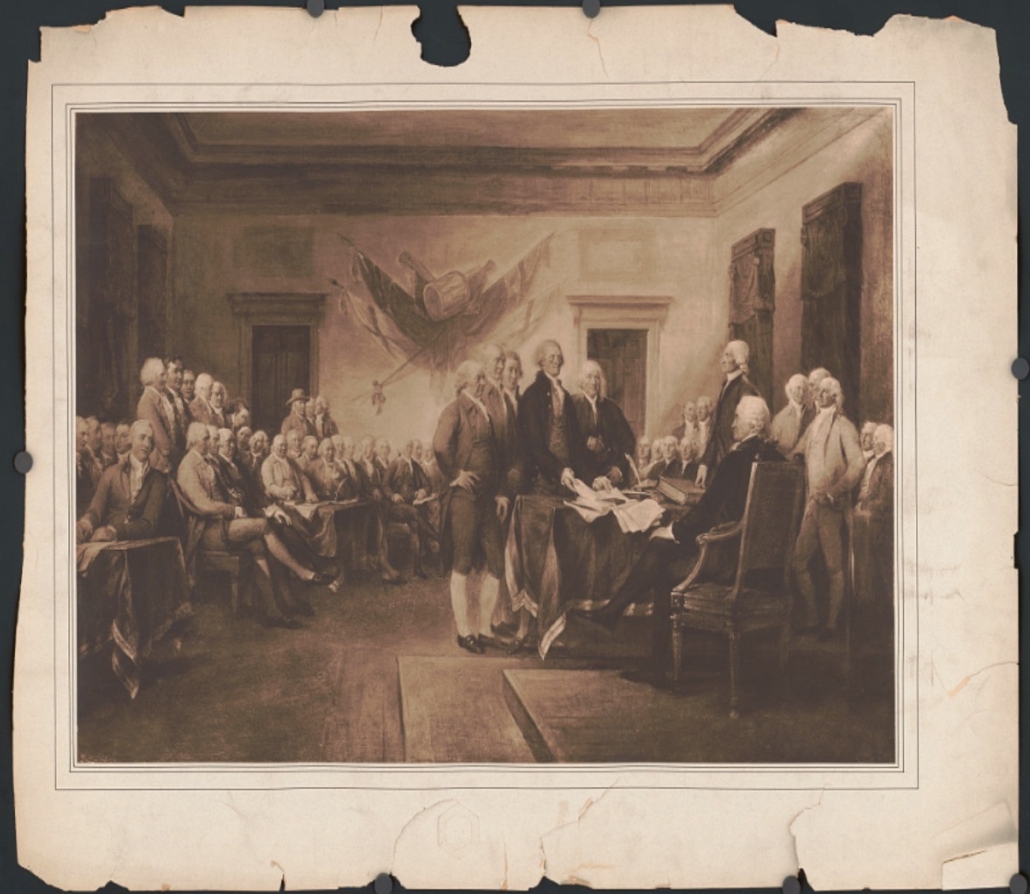
COMMITTEE OF FIVE PRESENTING THE DECLARATION OF INDEPENDENCE TO CONGRESS IN 1776.
The opening lines sought to convince Americans to put their lives on the line in the cause for independence. The document was intended for multiple audiences: King George III, the British people, American colonists, and the world at large.
The Founding Fathers sought to rally the troops, win foreign allies, and announce the creation of a new nation. The Declaration of Independence’s central premise was to announce America’s right to revolution.
Over five years of war followed the issuance of the Declaration of Independence. Locally, battles at Oriskany, Saratoga, Klock’s Field, and West Canada Creek, massacres at Andrustown and Cherry Valley, Tory raids at Shell’s Bush and Rheimensnyders Bush, and the1782 Little Falls gristmill attack continue to resonate down through the decades.
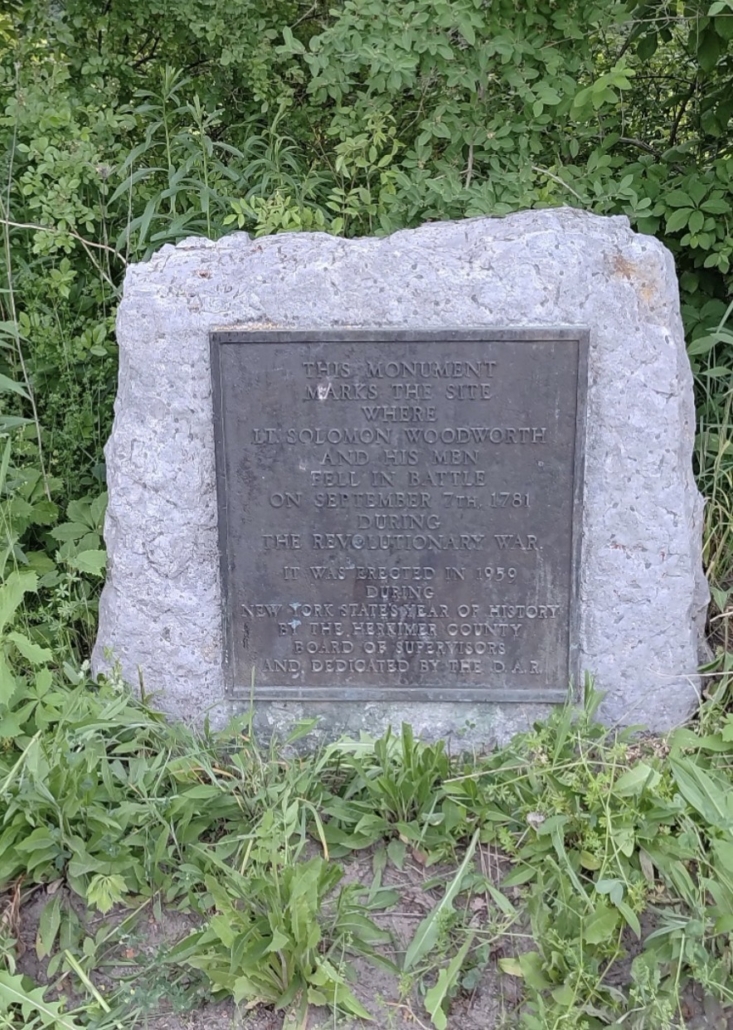
BATTLE OF WEST CANADA CREEK MONUMENT ON SMITH ROAD OUTSIDE HERKIMER.
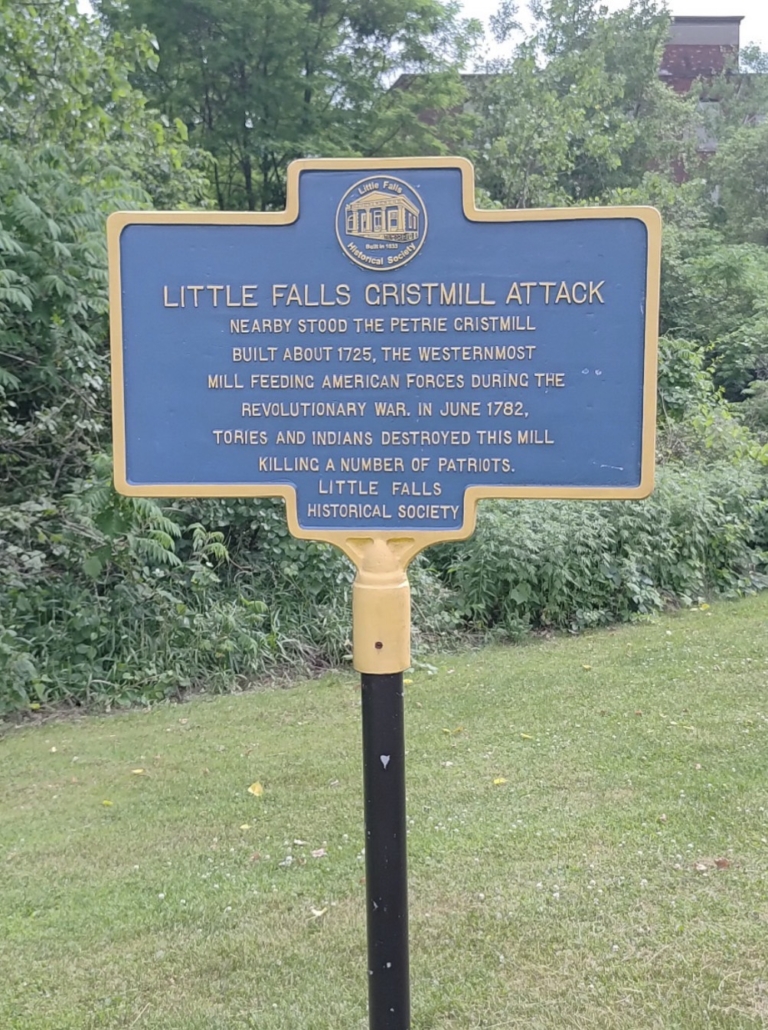
1782 LITTLE FALLS GRISTMILL ATTACK HISTORIC MARKER ON WEST MILL STREET IN LITTLE FALLS.
The Declaration of Independence was radical for its time. First, by declaring that “all men are equal,” then by proclaiming that each person has “certain inalienable rights,” and then asserting that governments derive their powers “from the consent of the governed.” Astonishing. Revolutionary. Democracy’s core principles.
SEEDS OF REVOLUTION
The 1730s – 1740s Great Awakening was the religious revival frenzy that swept colonial America sidelining traditional European-based religious beliefs and practices and spreading a radical egalitarian doctrine; a decidedly American religious identity emerged. Our Founding Fathers’ generation grew up in an America that had largely separated itself from European religious institutions; the next step of political separation was not such a radical leap of imagination.
LOCAL BACKGROUND
Even before military events began to unfold in New England, Mohawk Valley area residents had taken great personal risks supporting liberty, freedom, and independence. We all know that July 4, 1776 was the date of our nation-defining Declaration of Independence, but we also need to take pride in two earlier local documents.
In August 1774, the Tryon County Committee of Safety, meeting at Louck’s Tavern in Stone Arabia, drew up and affixed their names to a bold document declaring themselves patriots. And on May 21, 1775, the Palatine Committee of Safety put their necks even further “into the noose” by issuing their Declaration of Independence-like document, the first such step taken in New York. These brave actions preceded the penning of our national document by many months. Courage!
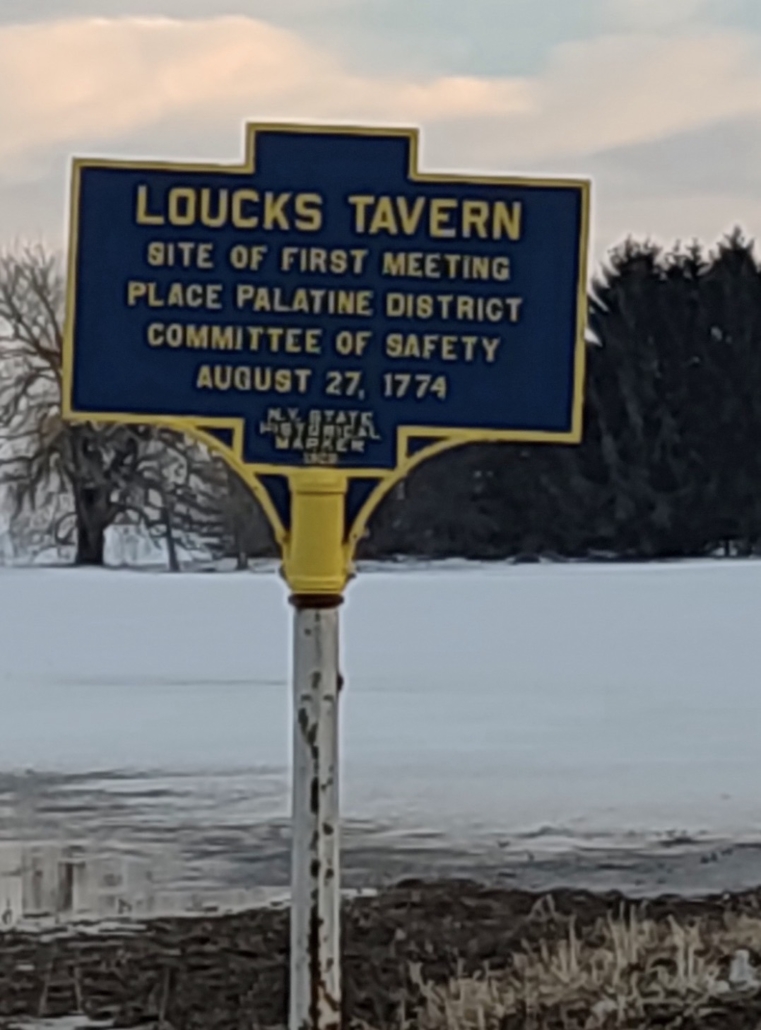
LOUCKS TAVERN HISTORIC MARKER LOCATED ON ROUTE 10 IN STONE ARABIA
A THREE-PART DOCUMENT
The Declaration of Independence was a towering statement of what America was all about and proclaiming to the world that America was a special kind of country embodying key human ideals. The document has three parts: the Preamble, a Listing of Grievances, and the Reasons for Separation. Each part has its own history and purpose.
The document’s Preamble states that governments exist to protect the rights of their citizens and that the colonists had the right to overthrow a tyrannical government. This soaring rhetoric sought to convince Americans to put their lives on the line for the cause of independence from Great Britain.
The Listing of Grievances articulated twenty-seven complaints and abuses against Great Britain’s King George III, intended to take the American cause away from the political realm and towards an armed struggle justifying self-defense. These grievances included the quartering of troops in colonial homes, the dissolution of colonial legislative law-making bodies, imposing taxes on Americans without our consent, and cutting off America’s trade to all parts of the world. These abuses all served as evidence of tyranny.
The Declaration of Independence’s second section clearly stated American rationale for seeking separation from British control. Thomas Paine’s 1776 pamphlet “Common Sense” used simple, powerful language to persuade American colonists to break from Great Britain. Paine wrote that it no longer made sense for a vast continent to be controlled by an island nation three thousand miles away. Paine’s words struck like a lightning bolt in colonial America.
The document’s third part was the Reasons for Separation and a thinly veiled declaration of war. The principles of the Preamble were being violated by repeated British actions outlined in the Listing of Grievances section, thus giving our Founding Fathers justification for the document’s third part, The Reason for Separation. Americans were technically British citizens, but we were not being granted the same rights as Englishmen. Revolution and independence were the only answer.
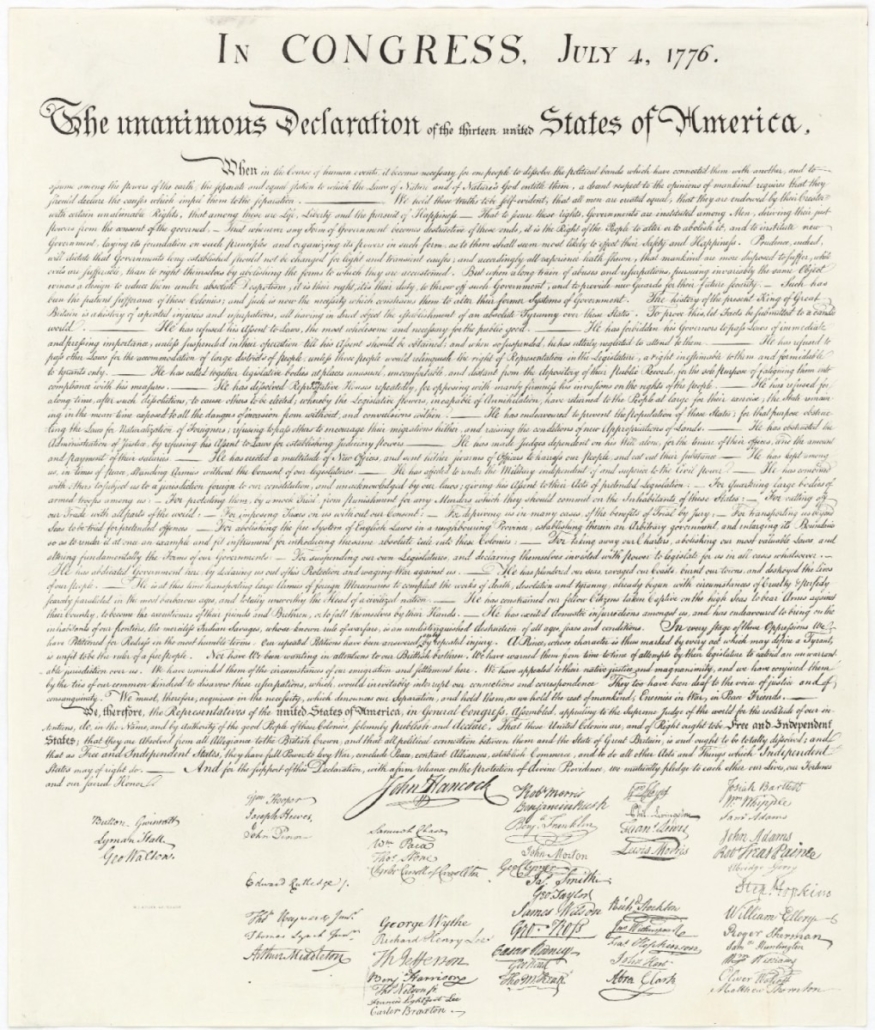
TEXT OF DECLARATION OF INDEPENDENCE WITH SIGNATURES
FOUNDING FATHERS’ 1776 MINDSET
All men are created equal, part of the Declaration of Independence’s opening words, was far from true in the late 18th century. Slavery existed and women had second class citizenship. Following the Civil War, the 13th Amendment abolished slavery, the 14th Amendment created Black citizenship, and the 15th Amendment called for Black voting rights. Southern states fought back with Jim Crow laws, denying such rights to former slaves. Equality was still a dream, racial and gender inequality the norm.
In 1920 the 19th amendment created women’s suffrage, Native American citizenship was guaranteed in the 1924 Indian Citizenship Act, and the 1964 Civil Rights Act and the 1965 Voting Rights Act sought to guarantee greater racial equality. The Founding Fathers’ words were closer to being true. Equality and a multi-racial democracy were in principle closer to reality.
LOOKING BACK 250 YEARS
Upon this important anniversary it is of course natural to wonder what our Founding Fathers would think of America in 2026. Perhaps they would be surprised that America’s revolution had become the world-wide model, in effect, “the shot heard around the world.” They would be pleased that America still exists as a unified nation two hundred and fifty years later given that America was so divided at its founding. Perhaps they would be surprised how we overcame division to create a unified nation.
Conversely, our Founding Fathers would be dismayed that our system of checks and balances is so stressed in modern times by bloated executive power and that there is so little acknowledgement of our shared values. Many fear that America is experiencing its worse nation-threatening challenge since the Civil War. The recent overturning of key protections of the Voting Rights Act can only be seen as a step backwards for equal rights. Some Americans seem comfortable pushing America backwards towards a racially divided society.
Additionally, our shared belief in the rule of law is under threat in our at-present deeply divided nation. We are left to wonder if this is the kind of nation that our Founding Fathers sought to create?
As we gather within our communities and with our families, we also need to seek the means to bridge our present political and cultural divisions. Converse civilly with those who we do not agree with. Find common ground.
We must also study and learn from our own nation’s history. And we must vote. Voter apathy allows unchecked power to exist.
Attend public gatherings, enjoy family picnics, and marvel at after dark fireworks!
Happy 250th birthday to our great nation and may democracy thrive in the century ahead!
JEFFREY GRESSLER IS A MEMBER OF THE LITTLE FALLS HISTORICAL SOCIETY
Published June 26, 2026.

 Herkimer Home State Historic Site with Garden