
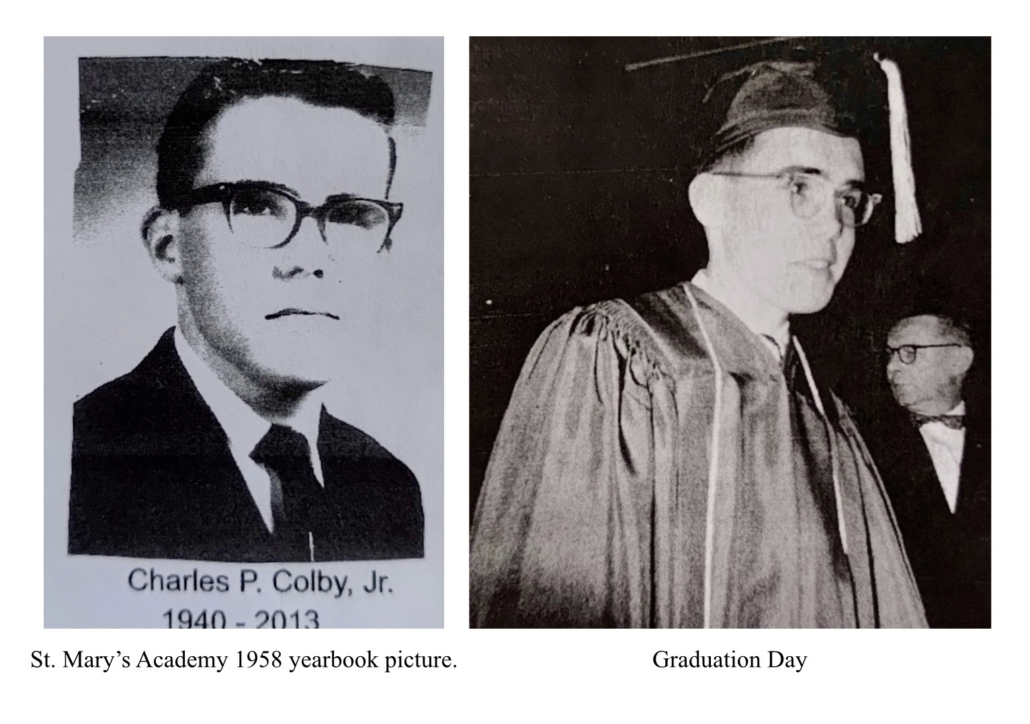
A Capacity For Achievement
By Michelle Colby, Debbie Flamish, Stephanie Lee and Sheila Mack
The purpose of the Charles P. Colby, Jr. Scholastic Achievement Award is to recognize and inspire students who have overcome significant inherent difficulties to earn high school diplomas. They are part of the fabric and character of Little Falls. None more so than Charles Colby, Jr.
Charlie was born in October 1940, and like a large part of his direct family, he called Little Falls home. He, his parents and younger sister, Sheila, lived on Lansing Street on the second floor of his grandparents’ house.
He attended school at Saint Mary’s Academy, consistently earning a place on the honor roll. Outside of school he enjoyed playing piano, bike riding, playing ball and going to the movies with friends. His dream was to become a jet fighter pilot.
Until August 19,1950.
While getting ready to go to the movies with friends, he went to get a drink of water but couldn’t turn the faucet with his left hand. He used his right hand instead and left to join his friends. He awoke the next morning feeling so seriously ill that a doctor came to the house. A spinal tap was performed on the kitchen table. The result of the tap was a diagnosis of poliomyelitis.
On August 23rd he was admitted to Children’s Hospital Home in Utica, NY, as the first polio victim in Herkimer County.
Polio had paralyzed his left arm, upper right arm, right leg and trunk.
Charlie spent the majority of his 10th year residing in a hospital 20 miles from home, his recovery and rehabilitation stretching over 8 months, the majority of that time confined in an iron lung.
Visiting hours were limited to Wednesday evening and Sunday afternoon, and while his parents made an effort to visit at least once a week, the first time Charlie saw his sister was in spring of 1951, over a month after his diagnosis.
Separated from family, home and normal life, Charlie had to accept the reality that while there might be some improvements, there would be no cures: he would never again be physically whole. How does a 10 year-old do that?
Looking back from adulthood, Charlie gave his answer:
“I had to accept that some physical activities were beyond my abilities, and didn’t like that circumstance. I pursued ambitions which were within my abilities…I didn’t view my physical condition as a challenge, but rather as a condition of existence. So rather than regret that I could not become a fighter pilot, I developed an interest in less physically-demanding activities such as mathematics and science. I became particularly interested in electronics and computers, with their potential to do work for me.”
While Charlie began adapting to a life-long routine of facing new realities, an informal network of family, friends and people in the community was forming and stepping in to help in ways both ordinary and unique.
Going into the hospital at the beginning of a school year, Charlie faced the first disruption to his education. He completed the 1950-51 school year (5th grade) through instruction in the hospital from the Utica Public School System. Showing support, his St. Mary’s classmates wrote to him during his stay, informing him of the goings-on in the 5th grade class. Discharged at the beginning of summer 1951, Charlie was determined to continue to achieve academically and extra-curricularly.
After returning home, Charlie became an active member of St. Mary’s Church Troop 24 Boy Scouts. His father worked with scout master John Finnegan to help make troop activities accessible for Charlie, such as planning hikes that ended at a site accessible by car so he could join the cook-out and related activities.
With significantly limited mobility, Charlie was unable to walk to school, a problem solved by a local funeral director who provided taxi service in the form of a Lincoln Town Car that transported Charlie to school each day.
In January 1953, he returned to Children’s Hospital Center for the first of many surgeries/procedures to improve his mobility. As the procedures stacked up, so did the medical bills. Again, the community recognized the challenge, and a neighbor suggested that Charlie’s parents reach out to the Shriners for assistance. They did, and the next set of surgeries/procedures was completed at the Shriner’s Hospital in Springfield, MA, in 1954 and 1955. Despite the distance, Charlie’s parents continued weekly visits to Springfield while relatives provided care for Sheila.
Throughout all the changes and disruptions in settings, systems and schools, Charlie continued to make honor roll status and earn accolades: delegate to Boys’ State, writing awards, president of French club and editor of Saint Mary’s yearbook. He excelled in science and math beyond the expertise of the staff at Saint Mary’s so was enrolled in advanced courses at Little Falls High School across the street. And he was valedictorian of Saint Mary’s Academy Class of 1958.
Charlie returned to the hospital in Utica for surgery once more, in his senior year. Knowing that finances were limited and that he would need funding to pursue studies after high school, he applied for and received:
- a National Merit Scholarship
- Regents Scholarship
- special Regents scholarship for education in engineering, chemistry,
- physics or mathematics.
He earned a bachelor’s degree in physics at Rensselaer Polytechnic Institute in Troy, NY, a masters degree in physics from Syracuse University, and had a career as a mathematical analyst for IBM, working on the National Airspace System and satellite imaging.
He also married, fathered three daughters, drove a car, maintained a house made more usable through ingenious modifications to fit his capacity.
Charlie would never say it, but In all endeavors and by any measures, he far exceeded his “conditions of existence.”
NOTE: The $1000 Charles P. Colby award is given out each year to a graduating Little Falls High School senior who has overcome significant challenges to achieve academic success. The Little Falls Historical Society finances this award through the assistance of a friend of Charles P. Colby who wishes to remain anonymous.
This was first published on the Little Falls Historical Society website.
Published May 7, 2026.
 Telethon hosts Rebecca McLain, Joe Kelly, and Morgan Mielnicki (left to right), 2025, photo by Mark DiOrio, Momentworks Photography